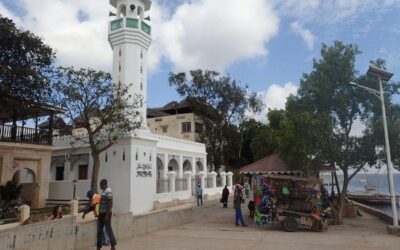
Siyu Friday Musjid and Historic Mimbar – Pate Island
- Depart from Lamu Town. Hire a private motorboat or traditional dhow from the main jetty in Lamu Town or Shela on Lamu Island. Public passenger boats also run periodically toward Pate Island, though schedules depend heavily on the tides.
- Navigate the Mangrove Creek. The boat journey takes roughly 45 to 90 minutes depending on the vessel and sea conditions. Boats travel northeast past Manda Island and enter a narrow, winding mangrove channel leading directly to Siyu.
- Time the Tides. Ensure your departure is planned around high tide. At low tide, the mangrove creek becomes too shallow for motorboats to reach the Siyu landing area, which can force a long walk across tidal mudflats.
- Walk to the Masjid. Once your boat docks at the Siyu landing point, the Siyu Mosque sits right inside the main village, just a short 5-to-10-minute walk along the sandy footpaths from the shore and near Siyu Fort.
-
The historic Friday Musjid of Siyu is situated in the ancient Swahili settlement of Siyu, on Pate Island in the Lamu Archipelago, along the northern coast of Kenya. The Musjid is particularly renowned for its historic wooden Mimbar, a rare surviving example of traditional Islamic woodworking on the East African coast.
-
The most remarkable feature of the Musjid is its beautifully crafted wooden Mimbar, which serves as the pulpit from which the Imam delivers the Friday Khutbah. A carved inscription on one of its steps records the date 930 AH, corresponding to 1523–1524 CE. This makes the Mimbar an important historical artefact, providing evidence of the established Muslim community and sophisticated craftsmanship that existed in Siyu during the sixteenth century.
The Mimbar is especially significant because surviving historic wooden pulpits of this age are uncommon along the East African coast. Its construction reflects the advanced woodworking traditions for which Siyu became known, particularly its skilled carpenters and craftsmen. -
Siyu itself was one of the important historic Swahili settlements in the Lamu Archipelago. Its history extends back at least to the fifteenth century, although archaeological research suggests that its origins may be considerably older. The town developed into a prosperous centre of trade, Islamic scholarship and traditional craftsmanship.
-
Historical accounts indicate that Siyu was home to numerous Musjids, with at least eight historic places of Islamic worship reported in the settlement. Its residents followed the Shafi’i school of Islamic jurisprudence, while scholars and religious families contributed to the development of Islamic learning throughout the region.
-
The settlement is also famous for Siyu Fort, a nineteenth-century coral-stone fortification traditionally associated with the local leader Bwana Mataka, whose full name was Mohammed Ishaq bin Mbarak bin Mohamed bin Oman Famau. Unlike the forts at Lamu and Mombasa, which were established by foreign powers, Siyu Fort was constructed by local inhabitants to defend their settlement against outside domination.
-
Siyu’s historical significance extends beyond its fortifications. Its coral-stone buildings, historic tombs, traditional houses and Islamic monuments reflect the prosperity and cultural achievements of the Swahili civilisation along the East African coast.
The historic Mimbar of Siyu remains a particularly valuable connection to this past, preserving an inscription from more than five centuries ago and demonstrating the longstanding presence of Islam in the Lamu Archipelago.