Nur al-Din Zangis Grave & Madrasa
How to Get Here
-
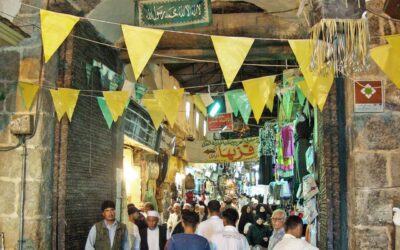
From the Umayyad Musjid: Travel towards the Tailors’ Souq (Souq al-Khayyatin), southwest of the Musjid.
-
On foot: From the eastern end of Al-Hamidiyah Souq, walk south towards the Tailors’ Souq. The Madrasa is approximately five minutes away.
-
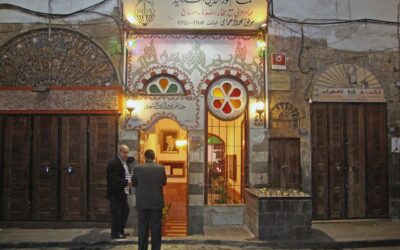
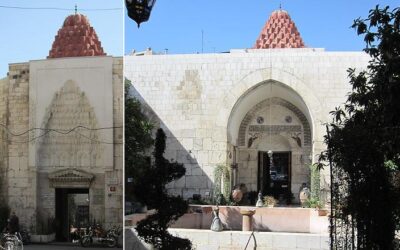
Finding the entrance: The entrance is relatively discreet and can be easy to miss among the market shops. The distinctive pointed Muqarnas dome above the tomb is a useful landmark.
-
The Grave of Nur al-Din Zangi is situated within Madrasa al-Nuriyya al-Kubra (The Great Nuriyya Madrasa), along Souq al-Khayyatin (the Tailors’ Market) in the historic walled city of Damascus, Syria. The complex is one of the most important surviving examples of medieval Islamic architecture in the city and contains the tomb of the renowned Muslim ruler Nur al-Din Mahmud ibn Zangi.
-
Nur al-Din Zangi was born in 1118 CE and belonged to the Zangid dynasty, which ruled important territories across Syria and northern Mesopotamia during the twelfth century. He succeeded his father, Imad al-Din Zangi, and became ruler of Aleppo before extending his authority to Damascus in 1154 CE. He became widely recognised for his commitment to Islamic governance, religious institutions and the struggle against the Crusader states.
-
During his rule, Nur al-Din supported the establishment of Musjids, Madrasas, hospitals and other charitable institutions throughout his territories. He placed particular importance on Islamic education and the promotion of religious scholarship, helping Damascus develop into an important centre of Islamic learning.
-
Madrasa al-Nuriyya al-Kubra was established in 1167 CE under his patronage. It is regarded as the first royal Madrasa complex of its kind in Damascus. The institution brought together religious education, congregational worship and the burial place of its founder within a single architectural complex. Some later historical and travel references give 1172 CE as its founding date, although the architectural documentation records 1167 CE in the original foundation inscription.
-
The Madrasa was designed around a central courtyard measuring approximately 16.6 by 20.6 metres. Its original layout included teaching rooms, prayer facilities, iwans (vaulted halls), a central water basin and a fountain. The courtyard was decorated with black and white marble flooring, while the surrounding rooms provided facilities for students and scholars.
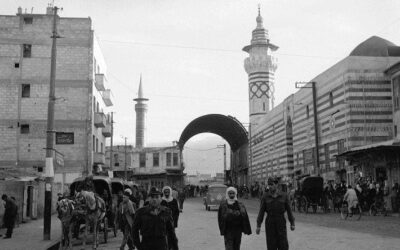
The prayer hall is situated along the southern side of the courtyard and contains a Mihrab indicating the direction of the Qiblah towards Makkah. A Minbar was also incorporated into the prayer area, while a minaret with a wooden balcony rises above the eastern section of the complex. -
The mausoleum is one of the most distinctive features of the building. It is situated beside the main entrance and contains the tomb of Nur al-Din Zangi beneath an intricately decorated Muqarnas dome. The square burial chamber measures approximately 6.6 metres on each side. Its walls feature decorative niches and Qur’anic calligraphy, including inscriptions from Ayat al-Kursi. The tomb itself is marked by a cenotaph bearing inscriptions dedicated to the memory of the ruler.
-
Nur al-Din Zangi passed away in 1174 CE and was buried within the Madrasa he had established. His burial place became an important historical landmark, preserving the memory of a ruler whose contributions to Islamic civilisation extended beyond military and political achievements.
-
The Andalusian traveller Ibn Jubayr, who visited Damascus during the twelfth century, admired the beauty of the Madrasa and described its architectural features and water arrangements. His account provides an important historical reference to the reputation of the institution during the medieval Islamic period.
-
The complex also contains another historic burial chamber associated with Amir Jamal al-Din Aqqush al-Najibi, a governor of Damascus under Sultan Baybars I, who died in 1269 CE. His tomb is situated adjacent to the northern entrance area and is distinguished by its own decorated Muqarnas dome.
-
Over the centuries, parts of the original Madrasa were altered. The northern section of the courtyard was demolished during road-widening works, resulting in the loss of some of its original architectural features. Nevertheless, significant portions of the complex, including the founder’s mausoleum, courtyard walls, prayer area and distinctive dome, have survived.
Today, Madrasa al-Nuriyya al-Kubra remains an important monument in the Islamic history of Damascus. It represents the legacy of Nur al-Din Zangi, whose patronage of religious education, architecture and charitable institutions helped shape the development of Islamic civilisation in Syria. His grave continues to be an important point of historical interest within the Old City.