Bab al-Jabiya
How to Get Here:
Bab al-Jabiya is located at the western end of Midhat Pasha Souq. From the Umayyad Musjid, walk west through the Old City towards the historic market. The gate is near the Sinan Pasha Musjid and marks the entrance to the souq.
-
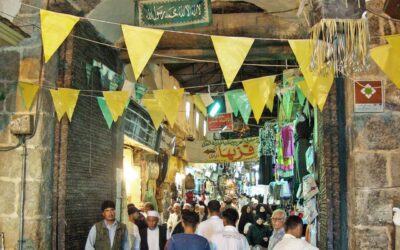
Bab al-Jabiya is one of the seven historic gates of the Old City of Damascus, Syria. Situated on the western side of the ancient city, it marks the entrance to the famous Midhat Pasha Souq, which follows the western section of the historic Straight Street. The gate has served as an important entrance to Damascus for centuries and remains part of the city’s living commercial quarter.
-
The site dates back to the Roman period, when Damascus was laid out with a network of straight streets and fortified entrances. The original gate had three openings: a large central passage for wheeled vehicles and two smaller side passages for pedestrians. It formed the western end of the Roman east–west road, commonly known as the Via Recta or Straight Street, which extended across the city towards Bab Sharqi on the eastern side.
-
The name Bab al-Jabiya is associated with Jabiya, a settlement in the Golan region that was historically connected with the Ghassanids. The gate became particularly significant during the Muslim conquest of Damascus in 634 CE (13 AH). According to the traditional account, the Muslim commander Abu Ubaydah ibn al-Jarrah entered the city through Bab al-Jabiya under an agreement of peaceful surrender, while Khalid ibn al-Walid entered through Bab Sharqi. The two forces subsequently met along the city’s main thoroughfare.
-
During the reign of Nur al-Din Mahmud ibn Zangi, the gate underwent major reconstruction as part of his efforts to strengthen and restore Damascus. The gate was rebuilt in 560 AH (1164 CE), reusing large Roman stone blocks. The work was subsequently completed under the Ayyubid ruler al-Malik al-Mu’azzam in 624 AH (1227 CE). An inscription associated with the gate also records Nur al-Din’s patronage and a date of 567 AH (1171–1172 CE). These dates reflect different stages of the gate’s reconstruction and inscription history.
-
Further repairs were carried out during the Ayyubid and Mamluk periods. The surviving structure therefore reflects several centuries of construction and restoration, incorporating elements from the earlier Roman gateway alongside medieval Islamic architectural features.
-
Bab al-Jabiya also played an important role in the commercial life of Damascus. The markets outside and around the gate served merchants and travelling caravans arriving from western and southern routes. Its position connected the Old City with roads leading towards regions such as Palestine and the Mediterranean coast. The nearby market developed into what is now known as Souq Midhat Pasha.
-
Today, Bab al-Jabiya remains an active passageway within the historic souq. Shops and market stalls surround the entrance, and visitors can still walk beneath its historic stonework. Although much of the original Roman structure has been altered or incorporated into later buildings, the gate remains an important surviving landmark in the history of Damascus.
-
For visitors, one of the most interesting features is the historic Arabic inscription above the passage, which records the medieval rebuilding associated with Nur al-Din. The surrounding market also provides an opportunity to explore the historic commercial streets of Old Damascus and follow the ancient route of Straight Street towards Bab Sharqi.